
Is a Formal E-Commerce Website Necessary in 2026? How People Actually Sell Today
For Instagram, copy the link and share it in your story or bio
Is a Formal E-Commerce Website Necessary in 2026? How People Actually Sell Today
For the past twenty years, the playbook for starting a commercial venture followed an unwritten, expensive rule: if you want to sell products or services online, you must build a "formal" e-commerce website.
That meant buying a domain, contracting a web developer, subscribing to a platform like Shopify, Magento, or WooCommerce, configuring dozens of third-party apps, styling complex product detail pages, setting up merchant accounts, and crossing your fingers that visitors would land on your homepage, browse your categories, add items to a cart, and complete a four-step checkout.
Fast forward to 2026, and that entire mental model has been flipped on its head.
Today, mobile devices account for over 75% of global digital commerce traffic, yet traditional e-commerce checkout funnels continue to suffer from average mobile cart abandonment rates exceeding 70%. Consumers have grown impatient with slow-loading storefronts, intrusive cookie banners, mandatory account registrations, and multi-step forms. At the same time, social platforms, instant messaging networks, and fintech infrastructure have evolved into complete, self-contained transaction ecosystems.
This brings us to the critical question facing entrepreneurs, boutique brands, creators, and service providers in 2026: Do you really need a formal e-commerce website to sell your products or services?
Here is the direct answer, followed by a breakdown of the new, agile ways people are generating millions in sales today.
The Short Answer: No, You Do Not
The short answer is no. In 2026, a traditional, monolithic e-commerce website is no longer a prerequisite for commercial success. In fact, for many small businesses, independent retailers, and service providers, launching a heavy e-commerce store is an expensive distraction that drains capital, slows time-to-market, and introduces unnecessary friction.
Selling in 2026 has transitioned from "destination commerce" (forcing people to visit your website) to "frictionless commerce" (meeting customers directly where their attention and intent already exist).
While enterprise corporations with tens of thousands of SKUs and global multi-warehouse logistics still rely on complex e-commerce engines, the modern digital economy offers faster, lighter, and far more profitable alternatives for everyone else.
The 7 New Ways People Are Selling in 2026
If people aren't rushing to build traditional web stores, how are they actually making sales in 2026? Here are the seven dominant models redefining online commerce:
1. Conversational Commerce (WhatsApp, DMs & AI Concierges)
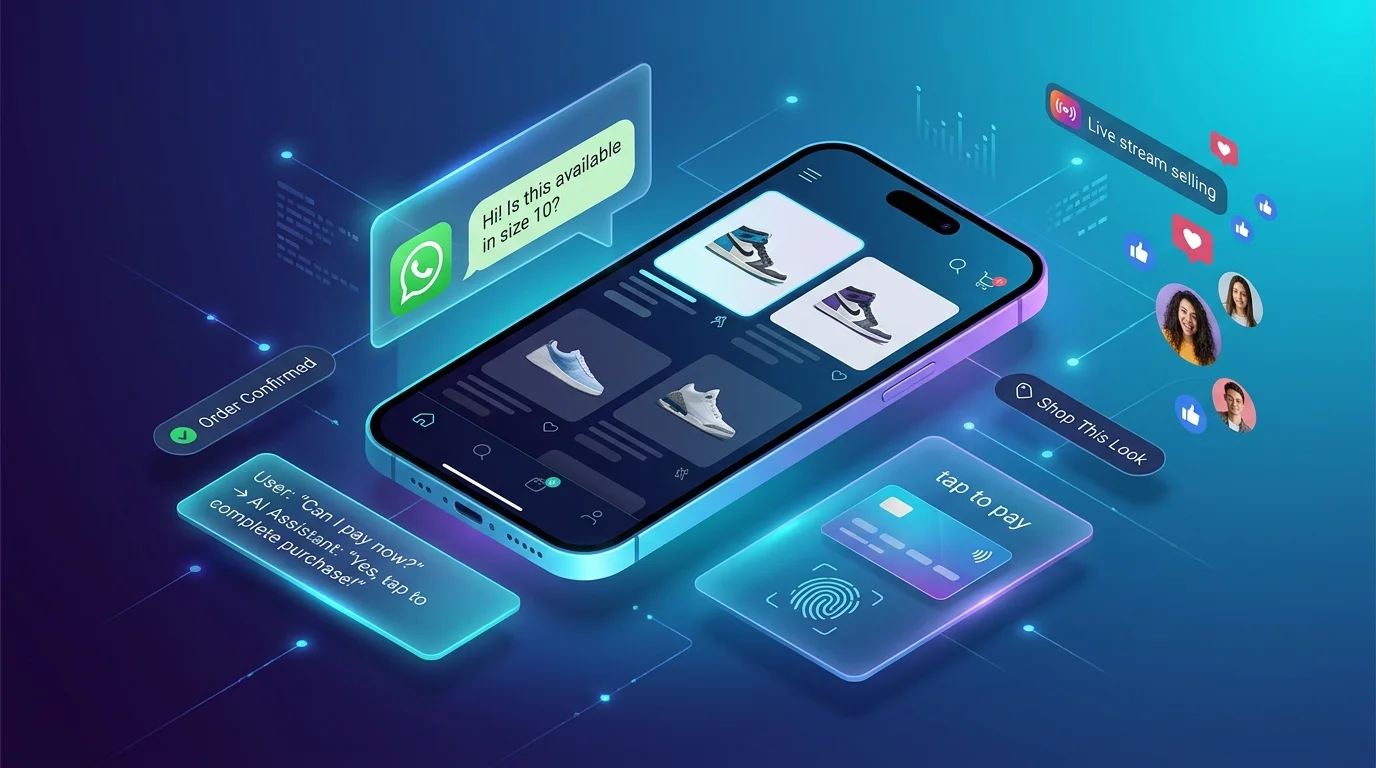
In Latin America, Southeast Asia, and Europe, messaging apps are the actual storefront. Instead of navigating an impersonal website, customers want immediate dialogue: "Do you have this in size 10?", "Can this be delivered by Friday?", or "Can you recommend the right package for my team?"
- How it works: Businesses present their catalog via quick-sharing links or interactive menus and close the deal directly inside WhatsApp Business, Instagram Direct, or Telegram.
- The 2026 AI layer: Intelligent AI assistants now manage first-line inquiries 24/7, check stock availability, generate dynamic quotes, and send instant one-tap payment links directly within the chat thread.
- Why it converts: Conversational commerce converts at rates 3x to 5x higher than passive website browsing because it builds real-time trust and eliminates buyer hesitation instantly.
2. Spreadsheet-Powered Micro-Stores & Lightweight Catalogues
One of the fastest-growing trends among agile businesses is replacing heavy CMS platforms with lightweight, spreadsheet-synced storefronts.
- How it works: Instead of maintaining a complex database, merchants manage their inventory, pricing, variations, and descriptions in a familiar tool like Google Sheets. Platforms like maakoo instantly transform that spreadsheet into a high-speed, mobile-first web catalogue with zero coding.
- Zero technical maintenance: When a product runs out or prices change, the merchant updates a cell in the spreadsheet, and the store updates in real time.
- Frictionless ordering: Customers browse the responsive catalogue and checkout via a streamlined WhatsApp order message, a single-tap payment link (Stripe or MercadoPago), or a downloadable order summary.
- Why it converts: It loads in milliseconds, feels like an app, requires no expensive monthly plugins, and keeps the merchant in full control of their data.
3. Native Social Commerce & In-App Zero-Click Shopping
Social platforms have completed their transformation from marketing channels into full-fledged marketplaces. Platforms like TikTok Shop, Instagram Shopping, and YouTube Shopping now allow users to discover, evaluate, and purchase products without ever leaving the application.
- In-Feed Purchases: A user sees a creator demonstrating a product in a video, taps the product sticker, and pays with biometric authentication (Apple Pay, Google Pay, or saved in-app credentials) in under ten seconds.
- Live-Stream Selling: Live shopping events continue to deliver staggering results, with conversion rates frequently reaching 15% to 30%—compared to the 2% to 3% industry standard on traditional websites.
- Why it converts: It capitalizes on immediate emotional impulse and eliminates the drop-off that occurs when forcing a user to open an external web browser.
4. Standalone Payment Links & Instant Digital Rails
In 2026, the concept of a multi-page "shopping cart" is frequently obsolete. Modern payment processors have turned checkout into a single URL.
- How it works: Using services like Stripe Payment Links, MercadoPago, PayPal, or local instant payment rails (Pix in Brazil, SPEI/CoDi in Mexico, UPI in India), sellers create reusable or dynamic payment links.
- Omnichannel deployment: These links are embedded directly into emails, pinned in social media bios, sent via text message, shared in direct messages, or encoded into physical QR codes.
- Why it converts: Buyers click once, tap their fingerprint or Face ID, and the transaction is settled. There are no forms to fill out, no passwords to create, and no friction.
5. Creator Economy & Gated Community Funnels
For knowledge workers, consultants, coaches, and creators, the sales funnel has migrated from corporate landing pages to private communities.
- The Ecosystem: Platforms like Skool, Substack, Discord, Patreon, and private Telegram channels have become self-contained businesses.
- The Strategy: Free educational content or public social posts channel interested prospects into private, high-value communities where subscriptions, digital downloads, cohort courses, and mastermind programs are sold directly.
- Why it converts: Community members buy because of belonging and ongoing relationship, which produces significantly higher customer lifetime value (LTV) and virtually eliminates customer churn.
6. Productized Services & Single-Step Booking Funnels
If you sell services—whether you are a web designer, accountant, legal advisor, or personal trainer—the idea of a multi-page website with a generic "Contact Us" form is dead.
- How it works: Service providers now "productize" their offerings into clearly defined scopes with transparent pricing.
- One-Step Conversion: Prospects select a service package and book a kick-off call or consultation on an interactive calendar (Calendly, Cal.com) that collects payment upfront via embedded Stripe integration.
- Why it converts: It respects the buyer's time by removing endless email exchanges and qualification calls, turning lead generation into an instant checkout.
7. Agentic Commerce & Generative Engine Optimization (GEO)
In 2026, consumers increasingly research products using conversational LLMs like ChatGPT, Perplexity, and Gemini rather than traditional search engines.
- The Trend: AI shopping agents search the web for the best recommendation based on user prompts.
- The Impact: These AI agents prioritize clean, structured product data and clear direct checkout endpoints over flashy graphical web pages. Brands optimizing for Generative Engine Optimization (GEO) ensure their product specifications and pricing are machine-readable, allowing AI agents to recommend their offerings directly to high-intent shoppers.
Comparison: Traditional Formal E-Commerce vs. Modern Agile Selling
| Dimension | Traditional Formal E-Commerce (Shopify / Magento / WooCommerce) | Modern Agile Selling (Conversational, Micro-Catalogues & Payment Links) |
|---|---|---|
| Initial Setup Time | 2 to 8 weeks | 15 minutes to 24 hours |
| Upfront & Monthly Costs | High ($50 to $500+/mo in platform fees, themes, and apps) | Very low to zero (pay mostly per transaction) |
| Technical Overhead | Continuous updates, plugin conflicts, security patches | Zero maintenance; runs on existing tools (Sheets, WhatsApp, Stripe) |
| Mobile Experience | Often bloated, slow scripts, 70%+ cart abandonment | Ultra-fast, app-like, friction-free checkout |
| Customer Relationship | Impersonal web interaction, transactional email receipts | Direct personal dialogue via WhatsApp/chat, high trust |
| Data Ownership | Locked into proprietary SaaS ecosystems or fragile databases | Owned directly in spreadsheets, CRM, and direct contact lists |
| Best Suited For | 5,000+ SKUs, enterprise ERP, multi-warehouse global distribution | Boutique retail, creators, DTC brands, local shops, service providers |
When Do You Actually Need a Formal E-Commerce Website?
While most entrepreneurs can thrive without a formal store, there are specific scenarios where a dedicated e-commerce infrastructure remains essential:
- Massive Catalogs (5,000+ SKUs): If you manage a department store, automotive parts catalog, or broad-inventory wholesale business, you need deep relational database indexing, faceted search filters, and automated SKU management.
- Complex Multi-Warehouse Logistics: Companies operating automated third-party logistics (3PL) across multiple continents requiring real-time warehouse routing rules.
- Enterprise B2B Wholesale: Portals requiring custom corporate accounts, role-based purchasing hierarchies, tiered negotiated pricing, and net-30 invoicing integrations.
- Complex International Tax and Customs Compliance: Brands selling physical goods across dozens of sovereign tax jurisdictions that require automated duties calculation at checkout.
If your business does not fall into these categories, building a heavy formal e-commerce website is almost certainly premature optimization.
How to Choose Your Selling Model in 2026: A 3-Step Strategy
If you are launching a new product or looking to simplify your existing business in 2026, adopt this lean strategy:
- Step 1: Start with Minimum Viable Friction.
Do not spend thousands of dollars on custom web development. Create an agile product catalogue synced from a spreadsheet or deploy direct payment links. Validate that real people are willing to pay for what you offer. - Step 2: Own the Conversation.
Route your orders through high-touch channels like WhatsApp or personalized email. Talk to your first 100 customers directly. Learn their objections, answer their questions in real time, and refine your messaging. - Step 3: Distribute Widely, Transact Simply.
Use social media (TikTok, Instagram, LinkedIn, YouTube) strictly for discovery and trust-building. When prospective buyers express interest, don't force them through a labyrinth—give them a direct link, a chat trigger, or an instant checkout.
Final Thoughts
The question in 2026 is no longer "Do I have a website?", but rather: "How easy is it for someone to buy from me the moment they decide they want what I have?"
Formal e-commerce platforms were the answer to the internet of 2010. In 2026, commerce is decentralized, conversational, and instant. Focus on product quality, clear storytelling, and frictionless buying experiences. The businesses that win today are not the ones with the heaviest websites—they are the ones that make buying as effortless as sending a message.
Sources
- McKinsey & Company - "The Social and Conversational Commerce Imperative" (2025/2026) - https://www.mckinsey.com/capabilities/growth-marketing-and-sales/our-insights - Research on how in-app checkout, live-stream retail, and AI personalization are transforming digital consumer journeys.
- Gartner - "Predicts 2026: Digital Commerce Strategies and the Rise of AI-Driven Self-Service" - https://www.gartner.com/en/digital-markets - Industry forecast analyzing consumer preference for conversational interfaces and automated micro-transactions.
- Harvard Business Review - "The Death of the Traditional Sales Funnel" - https://hbr.org/2024/09/how-customer-journeys-are-changing - Strategic analysis on the decline of destination websites and the rise of decentralized commerce touchpoints.
- Baymard Institute - "49 Cart Abandonment Rate Statistics 2025/2026" - https://baymard.com/lists/cart-abandonment-rate - Benchmark data on e-commerce checkout friction, mobile abandonment, and mandatory account creation penalties.
- Shopify - "The Future of Commerce Report: Global Trends in Retail and DTC" - https://www.shopify.com/research/future-of-commerce - Analysis of unified commerce, social selling integrations, and mobile checkout behaviors.
- Statista - "Global Social Commerce Market Value and Projections (2024–2028)" - https://www.statista.com/topics/1280/social-commerce/ - Market sizing and demographic adoption metrics for in-app social transactions and live shopping.
- Forbes - "Why Decentralized Commerce Is Replacing The Monolithic E-Commerce Store" (2025) - https://www.forbes.com/sites/forbesbusinesscouncil/ - Insights on payment links, micro-catalogues, and agile retail stacks for modern entrepreneurs.
- Bain & Company - "Conversational Commerce: The Trillion-Dollar Messaging Opportunity" - https://www.bain.com/insights/topics/technology-report/ - Comprehensive study on WhatsApp Business and messaging-first commerce across emerging and mature markets.
- Insider Intelligence / eMarketer - "Social Commerce Forecast & Mobile Consumer Behaviors" - https://www.insiderintelligence.com/insights/social-commerce-trends/ - Data report on TikTok Shop, Instagram checkout adoption, and zero-click conversion flows.
- Stripe - "The State of Global Online Payments: Fast Checkouts, Digital Wallets, and Payment Links" - https://stripe.com/annual-updates - Technical analysis of biometric authentication, one-click checkouts, and the growth of standalone payment URLs.
Related posts

Why You Need an Independent Online Catalogue (Beyond Social Media and Marketplaces)
4 min readRelying solely on Instagram or Amazon for your sales is a risk. Discover why an independent online catalogue is essential for data ownership, branding, and long-term business stability.
Read more →
Goodbye to Debt: 7 Foolproof Methods to Fix Your SME's Finances
4 min readStop drowning in business debt. Learn 7 proven strategies to clean up your SME's finances, improve cash flow, and build a sustainable, profitable business.
Read more →
Zero Lead Leaks: Audit Your Code and Fix the Weak Points
4 min readStop losing leads to technical errors. Learn how to audit your conversion funnel, identify code issues, and plug the leaks that are costing you sales.
Read more →